Blastball
We ran this Blastball program up until 2024.
An introduction to team sports for ages 3 - 5
This is a "game " that has the potential to create a great deal of interest in baseball for players of a very young age. BLASTBALL is meant to be a FUN introduction to baseball. It is designed to generate fast-paced action, provide recreation and exercise, create enthusiasm and encourage children to continue to be involved in sports. It's an opportunity for the parents, as well as the players, to meet a lot of people and make new friends.
Our Blastball teams were generally scheduled to play two games per week. The length of each game was determined by the participants and their parents but was generally approximately 45 minutes. (We had no set pre-determined time limit.) Players were welcome to leave earlier - or stay later - depending on their individual interests and attention spans.
Parental help is not just encouraged, it is required!
- Play is on small teams at an introductory level with a sponge bat & ball on a non-competitive basis.
- We played games in groups of 5 (or 6) per side so there could be be lots of at-bats for each player and no sitting out.
- No score was kept; kids played just for fun, made friends, and learned teamwork.
- No glove nor helmet is required for Blastball (but we supplied some batting helmets so players could use them if they wished and ... just in case).
- Only one base is used and it *blasts* when jumped on.
- Blastball presents a hugh opportunity to help the kids develop their catching, throwing and hitting skills while learning to be part of a team, taking turns, and laying the basis for becoming "good sports" .
BLASTBALL is a developmental "game" invented and formerly marketed by the ATEC Athletic Training Company in the United States. (The "honking" base that play requires hasn't been available since before Covid hit.) Blastball is a very simple concept utilizing the skills of baseball in a fun, fast-paced activity for young players. With only one base and a foam bat and ball, it is much safer and less complex than T-Ball. Note: We supplied the bats and balls, as well as a honking base, to each team. We did not allow the use of personal bats without prior approval.
The game is an exceptional introduction to baseball for a number of reasons:
- It is fun and fast-paced with lots of chances to bat in a short time-span.
- It is easy to play, players have instant success.
- No glove or special equipment is needed by the player.
- It runs within a flexible time frame.
- It doesn’t cost a great deal to participate.
- It allows good and efficient use of facilities. (We played 2 or 3 mini-games simultaneously off to the side near the diamonds that our other leagues used.) A diamond is not required for Blastball games.
BLASTBALL offers the opportunity to teach all five basic fundamentals of baseball --- hitting, throwing, catching, running and fielding. It is also a ton of fun with fast, continuous action and simple rules.
We assigned 10 - 12 players to each team but games were all scheduled as "home & away" and required each team to play 2 mini-games simultaneously with the opposing team using split squads of 5 or 6 players each and bith team's Tees. i.e. Before each game, the team's roster was split in half to form two "squads". Games usually only lasted 30 minutes (or less) so getting each participant at least 3 or 4 good at-bats was an early season objective. Having each team "switch" to play so each squad played against both halves of the other team often proved unmanageable as it took too much time to organize. Regardless, the event usually finished with an "inter-squad" session with a team meeting, and refreshments.
For game play: Each squad batted through its entire order of 5 or 6 players, twice was recommended, before switching to the field while the other team's players batted. Fielding positions were usually: catcher, "pitcher", 1st base, and up to 2 fielders/rovers. Players were to be given the opportunity during each game to play each fielding position. In Blastball, the ball is hit after the coach yells "play ball" and the batter runs to the base. The object is to make the base "HONK" before a defensive player gets the ball and yells "BLAST". Note that each base has a "sweet" spot so pre-game practice jumps aren't a bad idea.
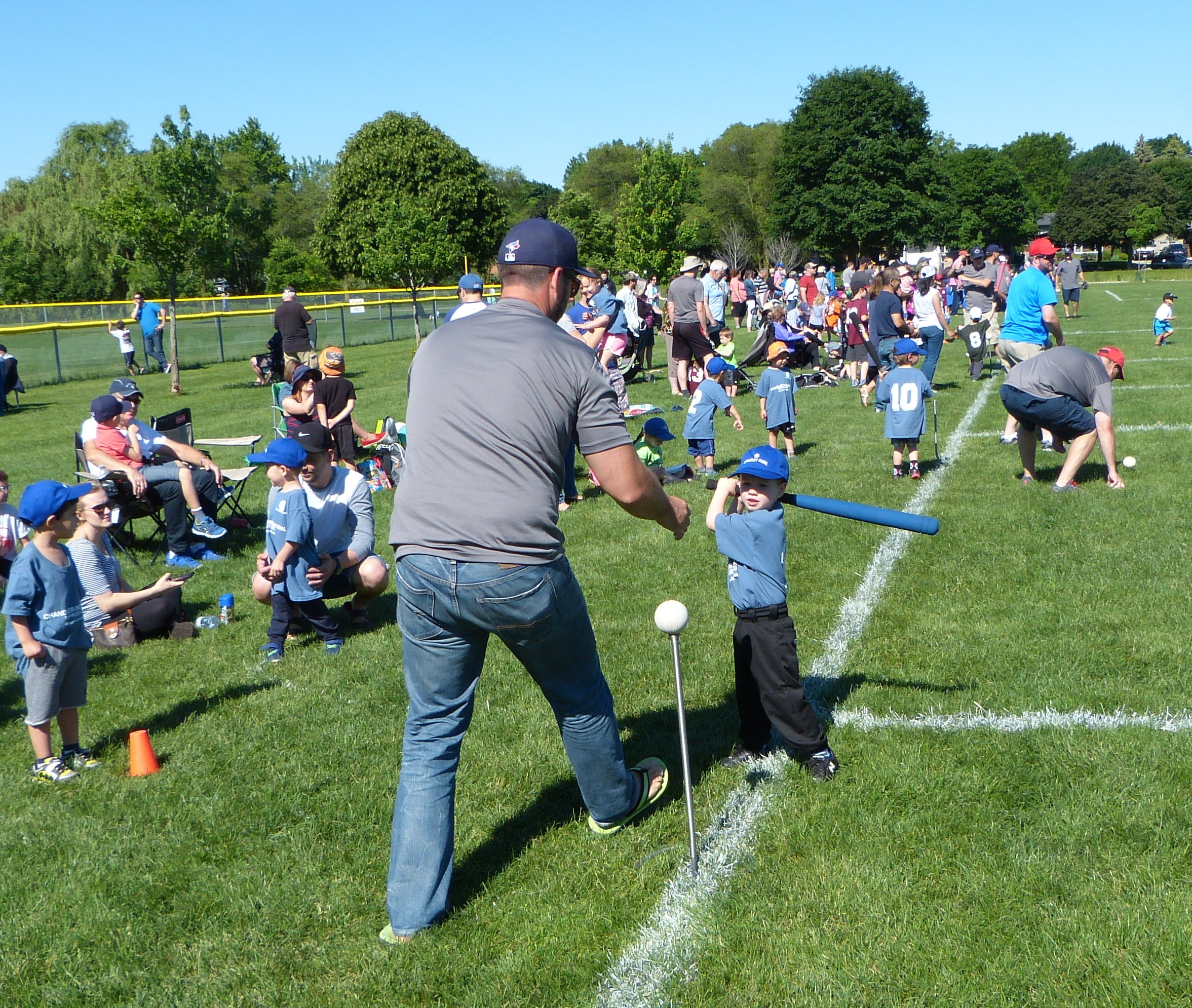
OUR SETUP for BLASTBALL: We learned not to schedule blastball events on diamonds! We designated specific areas on the grass well into foul territory by diamonds already booked for play by our other leagues. The opposing team's tees were set up approx. 40 ft. apart with all batters hitting parallel to each other into an open area. IF a 3rd team was also scheduled to participate, then ttheir Tee was also set up in the row and the rotation for each mini-squad game involved moving to both other Tees and then fisishing back at your own Tee with the other hald of your team. Ideally, play at each Tee would be about 10 to 15 minutes before rotating to the next one. (The photo to the left shows all of our Blastball teams set up for their final day of play on "Hot-Dog Day" 2017 at Wilson Park.
Offensive squad: There should be a batting coach, a first-base coach (directing the batter running to first and the "jump"), and an "on-deck" coach (prepping the next batter).
Defensive squad: There should be a coach (who also acts as the umpire and calls "play ball" with the catcher, and at least two field coaches.
Since we played our teams in 2 split-squads at scheduled game, there should be 6 (or more) volunteers from each team as each team has 2 mini-games being played simultaneously!
The players catch on to the game very quickly and the novelty of the noisy base may wear off. You should be ready to add small "additions" to the game to keep the kids challenged, remembering at all times that attaining success is the number one priority to having fun. Some such additions could be as follows:
- Add one throw and subsequent catch to a designated team-mate by the defensive player who fields the ball
- Have the ball thrown home to the catcher when fielded and the “catcher” places the ball on the Tee.
- Lengthen the distance to the base.
- Widen the vector for the hitters (i.e. place the "3rd baseline cone" further away from first).
Age guideline: We urged those wanting to register "under-aged" children to assess their child's interest, maturity, attention span, skill level, etc. as the league included children more than two years older. All players were expected to learn to take instruction from other adults, (coaches, helpers & such). All adults with players were required to help the team in some capacity.
Summary: There are mandated safety protocols, playing rules and procedures that everyone is expected to adhere to for the safety and well-being of all. Then the fun can happen!















.jpg)
.png)






.jpg)




.jpg)